
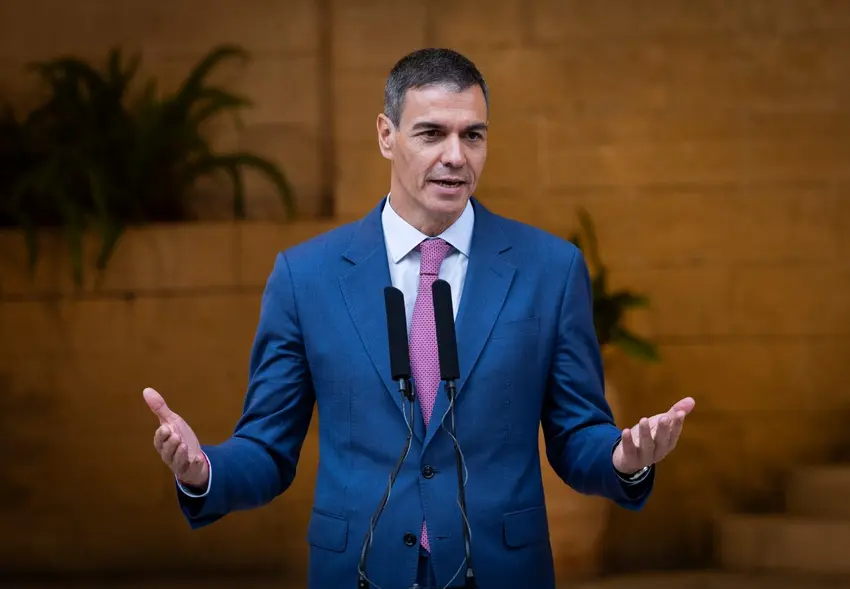
In a radio interview, the prime minister also denounced misinformation spread by the "ultra-right".
More than 70,000 migrants entered the small Spanish enclave in North Africa in late July, swimming or crossing on foot from neighbouring Morocco in a chaotic influx that left scores dead and fuelled fresh tensions in the European Union over migration.
Although the vast majority returned to Morocco within hours, thousands remain in the territory 18 square kilometres (seven square miles) in size, many living rough on the streets.
READ ALSO: EU nations patch things up after Ceuta migration discord
While the National Intelligence Centre (CNI) and police shared situation reports with the government, "I can assure you that no information made it possible to gauge the scale, the seriousness of the crisis we were going to experience on July 30th and 31st," Sánchez told Cadena Ser radio on Monday.
"We are continuing to investigate" what happened, Sánchez said.
Some analysts theorised that the crisis may have been a message sent to Spain by Morocco over the disputed Western Sahara – a former Spanish colony largely controlled by Morocco but claimed by the Algerian-backed pro-independence Polisario Front – following a visit by Sánchez to Algeria in July.
But the prime minister said that "no intelligence service with which the Spanish government normally cooperates" had suggested "any involvement in one way or another of the Moroccan authorities".
"We must be aware that this crisis can only be resolved through cooperation and not through distrust toward Morocco," he added.
READ ALSO: What happens to undocumented migrants after they arrive in Spain?
Disinformation
Ahead of the crisis, a Spanish Supreme Court ruled that irregular migrants arriving by sea cannot be immediately returned.
Sánchez noted on Monday that disinformation regarding the ruling then spread rapidly online, including by human trafficking groups, claiming that if someone entered Ceuta by swimming, it was impossible for them to be deported to Morocco, which is false.
"After July 30th and 31st, rumours and disinformation spread on social networks linked to Russia and Israel, and to an ultra-right international that always uses migration to attack both Spain and Europe and divide it," Sánchez added.
The fate of the migrants has become a major political flashpoint, with Spain's government facing demands from the conservative opposition and far-right parties for all those who entered, including minors, to be returned to Morocco.
The left-wing government has said between 3,500 and 7,000 migrants remain in the territory, while Ceuta's right-wing leaders allege it is at least 10,000.
Residents of Ceuta, which has a population of 80,000 people, have held regular demonstrations over what they say are security and hygiene problems linked to the influx.
Sánchez on Monday said that 6,000 spaces at reception centres would soon be available in the territory for migrants, whose status must be verified by the Spanish authorities before any possible return to Morocco.
He also pledged an additional €168 million in aid for Ceuta to respond to the crisis.
Comments (1)